Contemporary witness

ERNST GRUBE – DAS VERMÄCHTNIS (original title)
UFA FICTION GmbH • Documentary & Factual • 2022Sachsenhausen Memorial presents volumetric eyewitness interview in the presence of Holocaust survivor Ernst Grube
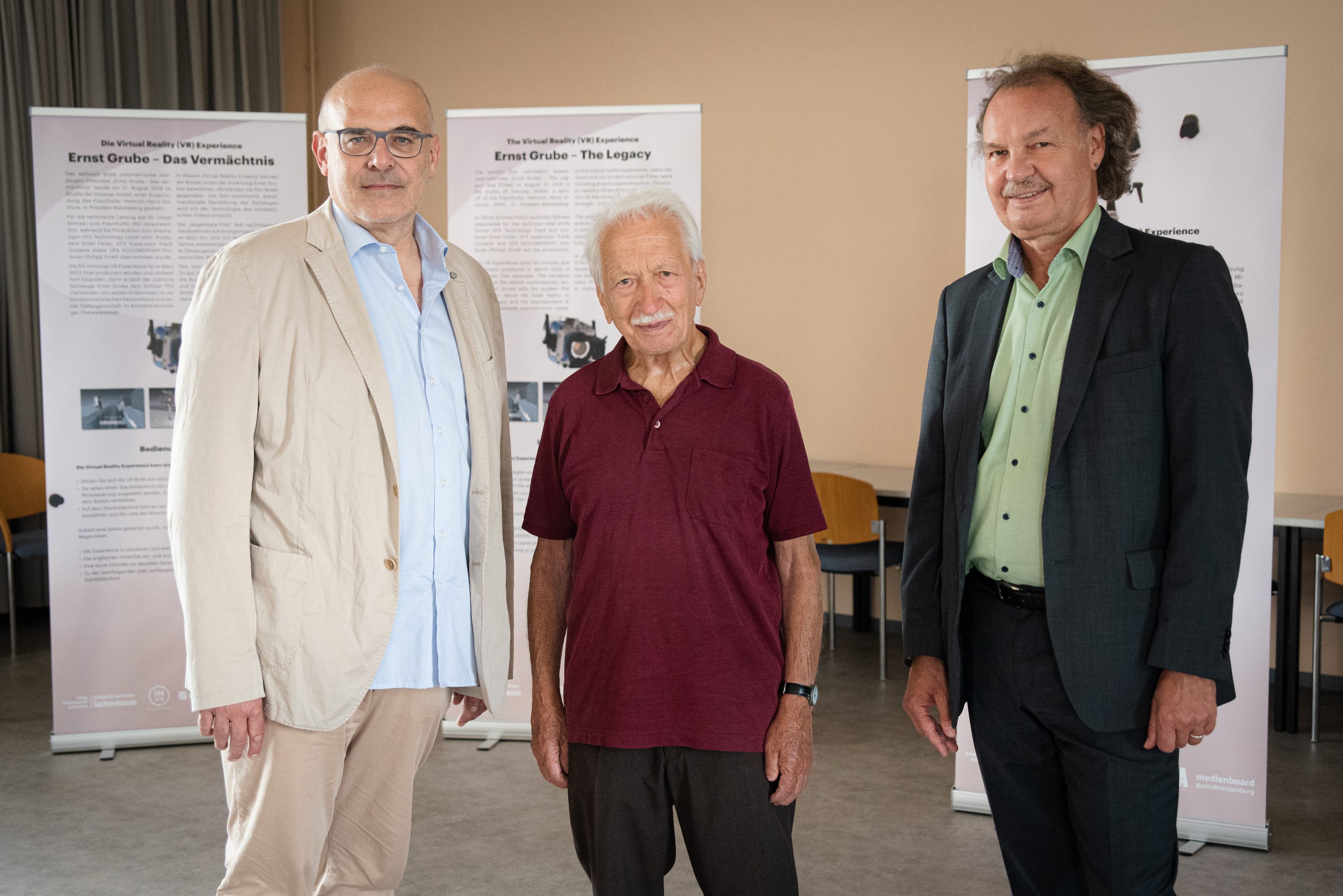
On June 28, 2022, the virtual reality project ERNST GRUBE – DAS VERMÄCHTNIS by UFA and the Fraunhofer Heinrich Hertz Institute was presented for the first time at the Sachsenhausen Memorial in the presence of Holocaust survivor Ernst Grube. The innovative volumetric eyewitness interview with Ernst Grube will be available to visitors to the memorial until the end of October.
At the kick-off event, Ernst Grube said: “Our reports as survivors of Nazi persecution were and are an important contribution to the multifaceted work of remembrance. These direct testimonies will be missing with our passing. Can the new volumetric presentation document and convey our stories more impressively? I myself am very impressed by the technical realization of this first example, which deals with my persecution and that of my family. Now I am curious and excited to see what effect it will have, especially on younger people who immerse themselves in this story. Will they be touched more intensely, think about it and ask questions?”
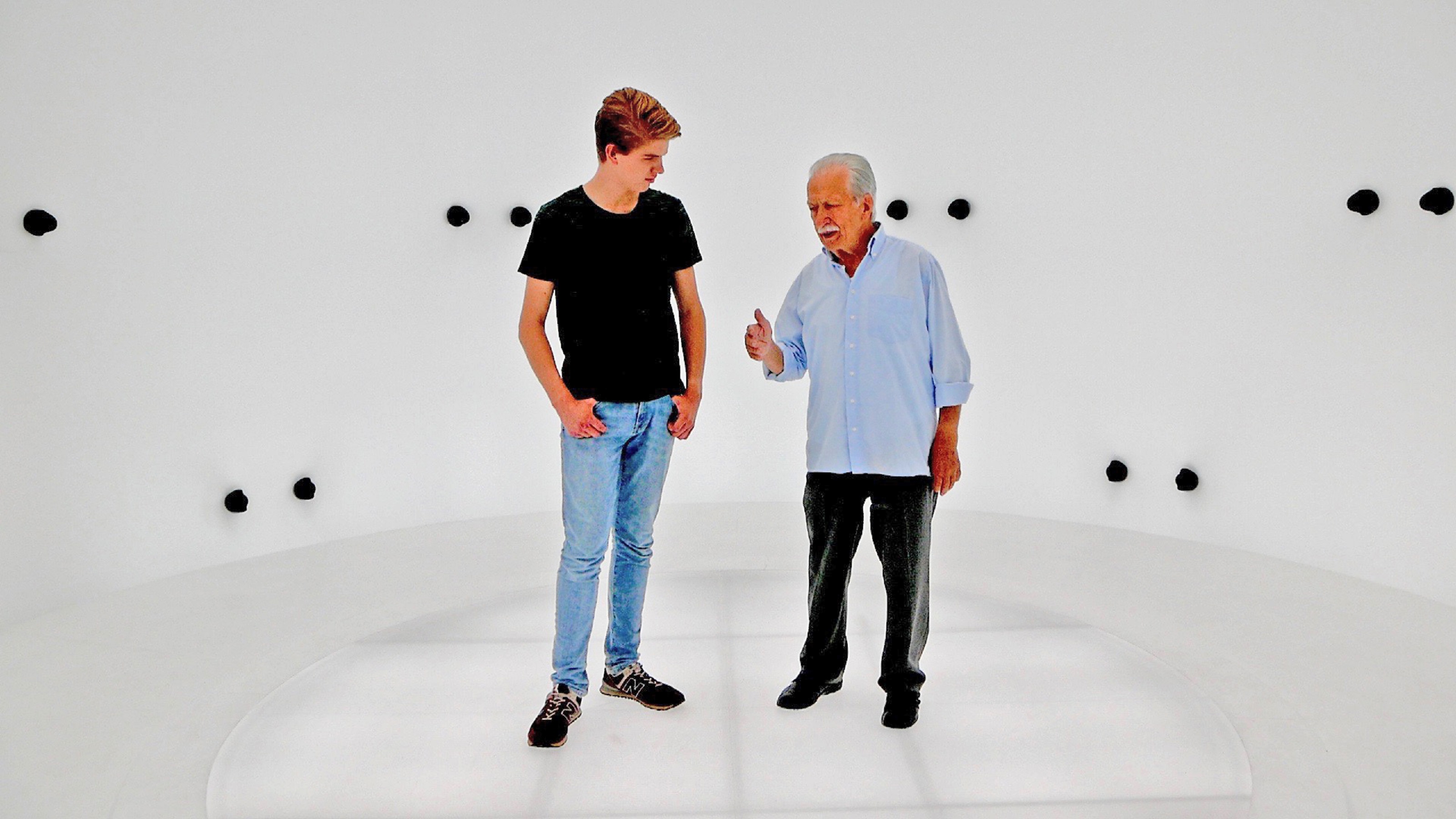
Born in Munich in 1932 to a Jewish mother and a non-Jewish father, Ernst Grube survived the Theresienstadt concentration camp-like ghetto. In August 2019, he was recorded with the help of 32 cameras in the volumetric studio as he recounted his experiences in Nazi Germany and his deportation to Theresienstadt to the then 16-year-old schoolboy Phil Carstensen. As a contemporary witness, Grube has been reporting on the persecution of his family in memorials, schools and educational institutions as well as in TV and radio reports for many years and is committed to living democracy. Ernst Grube is a long-standing member of the Association of Persecutees of the Nazi Regime / League of Anti-Fascists, President of the Dachau Camp Community and Chairman of the Board of Trustees of the Bavarian Memorials Foundation.
Oliver Schreer, Group Leader “Immersive Media and Communication” at the Fraunhofer Heinrich Hertz Institute and technical leader of the project, said: “With volumetric video, we have created a unique opportunity to preserve eyewitness interviews with Holocaust survivors for future generations and make them realistically tangible. The powerful and versatile technology we have developed offers enormous potential for education and the culture of remembrance. We are presenting our VR Experience ERNST GRUBE – DAS VERMÄCHTNIS to the public for the first time. A walk-through film with a Holocaust survivor in this form is unique worldwide. With the Sachsenhausen Memorial, we have found the ideal place to show our virtual reality project. Especially in times when anti-Semitic tendencies are becoming visible again, this is more important than ever.”
Joachim Kosack, Managing Director of UFA and UFA Serial Drama, added: “There are not many contemporary witnesses left who can tell us about the cruel Holocaust. It is therefore all the more important to keep these memories alive for younger generations. The aim of the ‘Eyewitnesses’ project, which UFA implemented together with the Fraunhofer Heinrich Hertz Institute, was to document the accounts of the atrocities of National Socialism for future generations and to make a contribution to the German culture of remembrance. With the help of volumetric video technology, the memories of Holocaust survivor Ernst Grube were recorded in a unique way in the volumetric studio of Volucap GmbH in Potsdam-Babelsberg and a walk-through film was produced from his life story. We are very proud and grateful that the Sachsenhausen Concentration Camp Memorial is now making our volumetric film ERNST GRUBE – DAS VERMÄCHTNIS accessible to the public. Especially now, when anti-Semitic tendencies are becoming alarmingly visible again, it is more important than ever to draw attention to this and we are very pleased that our VR experience can set a milestone in maintaining our necessary culture of remembrance.”
Helge Jürgens, Managing Director of Medienboard Berlin-Brandenburg, added: “The VR experience ERNST GRUBE – DAS VERMÄCHTNIS enables contemporary witnesses and their life stories to be experienced by future generations. We are delighted that we as Medienboard have been able to support this important project. It is precisely with innovative and immersive narrative forms that young people can be specifically addressed and reached with socially and politically relevant topics.”
Completed in March 2022 in cooperation with INVR.Space, the approximately 50-minute VR eyewitness interview with Ernst Grube consists of five episodes – from his childhood home in Munich to the Theresienstadt ghetto. Users can take part in Grube’s story as if they were standing directly opposite him. The photorealistic three-dimensional representation of the contemporary witness is achieved using volumetric video technology. A three-dimensional image of Ernst Grube is calculated from the video information, which can be integrated directly into a virtual world. The individual stages of his life are illustrated in a virtual environment and can thus be experienced in a new way.
Axel Drecoll, Director of the Brandenburg Memorials Foundation, explained: “With the presentation of the VR Experience ERNST GRUBE – DAS VERMÄCHTNIS, the Sachsenhausen Memorial is giving a space to a virtual reality application for the first time. We are currently researching in various projects how digital applications can be integrated into the memorial site and whether this supports learning at the historical site. We are working on our own virtual and augmented reality applications and will soon be testing them. Digital technologies allow survivors who are not on site in person to tell their story of persecution. Even buildings that no longer exist today could be made visible again with the help of digital applications. We are interested in whether visitors to the historical site consider digital technology to be a useful addition at all.”
In a room in the former prisoners’ laundry, four people can simultaneously experience the virtual encounter with contemporary witness Ernst Grube in three dimensions and life-size at a cube with the help of VR glasses. The memorial is asking users to take part in a short online survey afterwards in order to gain insights into the interest and acceptance of digital technologies at the historical site.
The presentation can be used on Fridays from June 29 to October 31, 2022 from 12:00 to 16:00 in the former prisoners’ laundry at the Sachsenhausen Memorial.
Information: www.sachsenhausen-sbg.de
The project ERNST GRUBE – DAS VERMÄCHTNIS was funded by Medienboard Berlin Brandenburg.
If you are interested in images of the event, please contact joana.bussmann@ufa.de.
Biography Ernst Grube
Ernst Grube was born in Munich on December 13, 1932. As the son of a Jewish mother and a Protestant, communist father, he and his two siblings were ostracized and persecuted by the National Socialists.
The building complex in which the family lived belonged to the Jewish Community. When all the Jewish tenants were evicted in June 1938 as a result of the National Socialist “Aryanization”, Grube’s parents initially resisted, but were forced to vacate their apartment, in which the gas, electricity and water had already been turned off, in November 1938.
Ernst’s parents took him and his siblings to a Jewish children’s home in Schwabing. Here, Ernst experienced a rich Jewish life with communal celebrations for the first time, which still touches him deeply today. The sense of security is overshadowed by measures of systematic exclusion. Jewish children were banned from attending school and had to wear the yellow star from September 1941. After the first transport in November 1941, they witnessed how more and more children from the home were deported.
In April 1942, the remaining 13 children – including the Grube siblings – were taken with their caregivers to the Milbertshofen collection and deportation camp and then to the “Home for Jews” in Berg am Laim. When this camp was dissolved in the spring of 1943, the children returned to their parents, who had found a place to sublet.
Because of their Jewish mother and their time in a Jewish children’s home, the National Socialists categorized the Grube children as so-called “Geltungsjuden”, which means “Jews of validity” and subject to all forms of discrimination and persecution. Only the deportation was postponed due to the parents’ “mixed marriage”. Despite repeated summonses to the Gestapo, the father refuses to divorce his wife. Nevertheless, Ernst Grube was deported to the Theresienstadt ghetto with his mother and two siblings in February 1945. There they experienced liberation by the Red Army on May 8, 1945.
After an apprenticeship as a painter with his father, Ernst Grube completed his A-levels and became a vocational school teacher. During the Cold War years, he became politically active against the rearmament of the Federal Republic of Germany and the appointment of former National Socialists to important positions. Due to his membership of the banned KPD, he was arrested several times and sentenced to prison. However, he successfully averted the threat of being banned from his profession.
Today, Ernst Grube is one of Munich’s best-known survivors of Nazi terror. As a contemporary witness, he reports on the persecution of his family in memorials, schools and educational institutions as well as in TV and radio reports and campaigns for a living democracy. Ernst Grube is a long-standing member of the Association of Persecutees of the Nazi Regime / League of Anti-Fascists, President of the Dachau Camp Community and Chairman of the Board of Trustees of the Bavarian Memorials Foundation.
The Virtual Reality (VR) Experience ERNST GRUBE - DAS VERMÄCHTNIS
The world’s first volumetric eyewitness interview ERNST GRUBE – DAS VERMÄCHTNIS was shot on August 21, 2019 in the studio of Volucap GmbH, a spin-off of the Fraunhofer Heinrich Hertz Institute, in Potsdam-Babelsberg. Dr. Oliver Schreer from Fraunhofer HHI was responsible for technical direction, while production was handled by former UFA Technology head and producer Ernst Feiler, VFX supervisor Frank Govaere and UFA DOCUMENTARY producer Philipp Grieß.
The final 50-minute VR experience was produced in March 2022 and comprises five episodes. In it, Jewish contemporary witness Ernst Grube tells young Phil Carstensen about his experiences in National Socialist Germany and his imprisonment in the Theresienstadt concentration camp.In this virtual reality experience, users can listen to Ernst Grube’s story as if they were standing directly opposite him. The photorealistic three-dimensional representation of the contemporary witness is achieved using volumetric video technology.
The “walk-in film” invites future generations to come to terms with National Socialism in a unique way. The virtual eyewitness protocol thus makes a valuable contribution to the culture of remembrance.
The volumetric interview with Ernst Grube is the first of its kind, which is intended to preserve the memories of the last contemporary witnesses for future generations by exhibiting them in educational institutions and memorial sites.
The Virtual Reality (VR) Experience - The volumetric video
Volumetric video is a new media format that provides a photorealistic, digital 3D representation of people. The format makes it possible to experience people in virtual worlds. There is no need for complex animation techniques. In particular, facial expressions and body movements can be realistically reconstructed.
The Fraunhofer Heinrich Hertz Institute has been researching this technology for more than ten years. The team led by Dr. Oliver Schreer, Ingo Feldmann and Peter Kauff received the Fraunhofer-Gesellschaft’s prestigious research award for this in 2019.
In a special cylindrical recording studio, the person is recorded from all directions using 16 pairs of cameras. The cameras with 20 megapixel resolution deliverraw data of 1.6 terabytes per minute. Using a computer vision-based processing method, a highly realistic 3D model is calculated for each video image.
The aim of this processing is to significantly reduce the data while retaining the geometric details and texture. This results in a sequence of 3D models that can then be played back in a 3D visualization tool and viewed from any angle.
This new form of digital reconstruction is particularly suitable for applications that require an authentic and realistic portrayal of people, such as witnesses to the Holocaust.
Why virtual reality at the memorial
With the presentation of the VR Experience ERNST GRUBE – DAS VERMÄCHTNIS, the Sachsenhausen Memorial is giving space to a virtual reality application for the first time. The volumetric images of Ernst Grube show the Holocaust survivor in virtual environments that visualize his narrative. Virtual reality enables a particularly interactive way of approaching Ernst Grube’s life story.
What is particularly exciting for the Sachsenhausen Memorial is how this application affects visitors. The memorial is currently researching in various projects how digital applications can be integrated into the site and whether this supports learning at the historical site. The memorial is working on its own virtual and augmented reality applications and will soon be testing them.
Digital technologies enable survivors like Ernst Grube, who were not there in person, to tell their story of persecution. Even buildings that no longer exist today could be made visible again with the help of digital applications.
The memorial is interested in whether visitors to the historical site consider digital technology to be a useful addition at all. In order to be able to develop multimedia offers according to the needs and interests of visitors, the memorial is asking them to take part in a short survey on the VR Experience “Ernst Grube – the legacy”.
Ernst Grube was deported to the Terezín concentration camp as a child in 1945; he was not imprisoned in the Sachsenhausen concentration camp. Theresienstadt (Terezín) is located in the Czech Republic today. After the German occupation of what was then Czechoslovakia, the National Socialists set up a concentration camp-like camp for around 141,000 Czech and German Jews in Terezín from November 1941. For many of them, Theresienstadt was a transit station to the Auschwitz extermination camp.
Even though Ernst Grube was not here, his life story shows how the lives of Jewish families continued to deteriorate during the National Socialist regime, first in Germany and later throughout Europe. His story is exemplary for many Jewish children and families who were persecuted by the National Socialists. Unlike Ernst Grube, many Jews did not survive deportation to concentration and extermination camps.
Play credits
Pause credits